
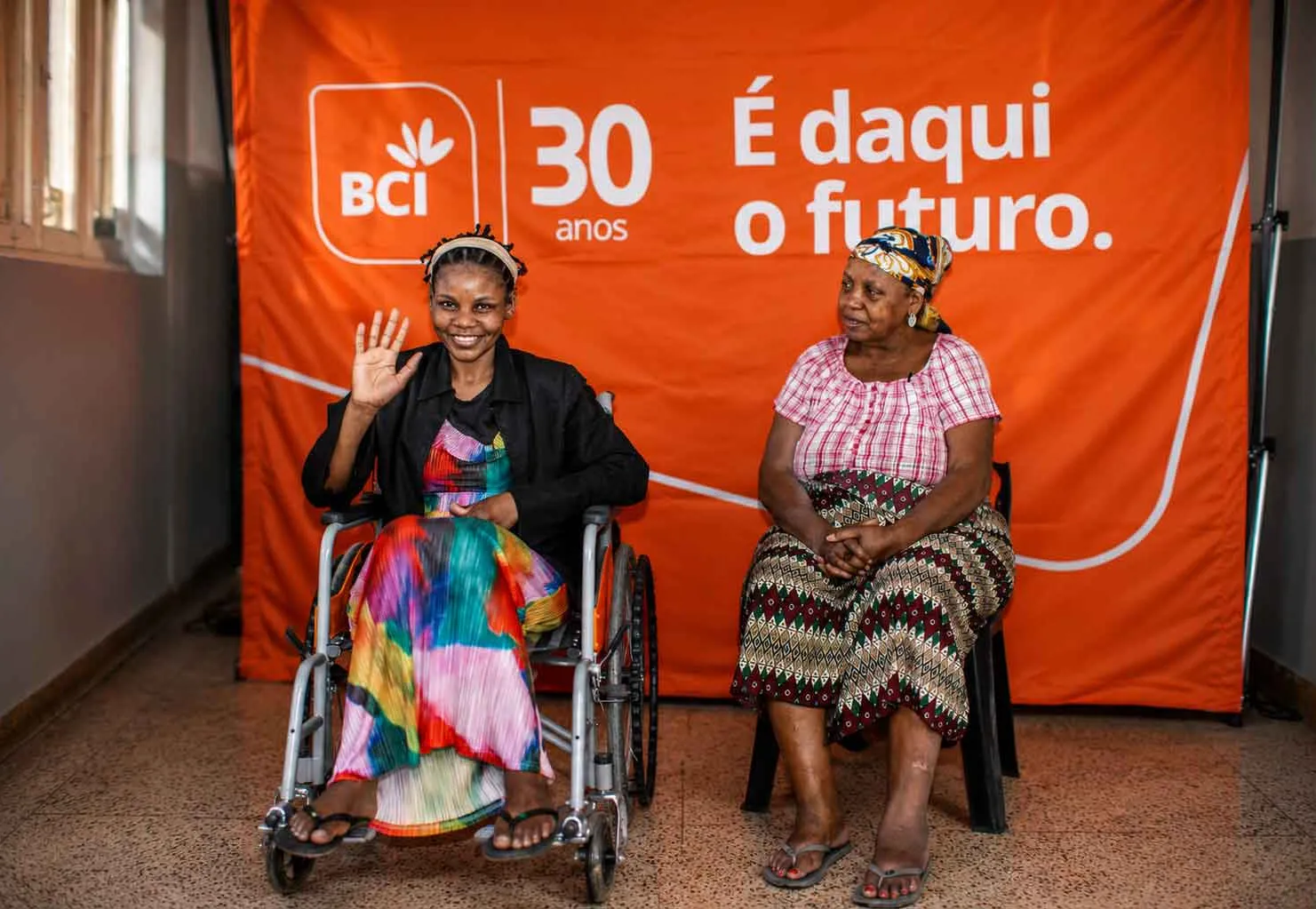
BCI is carrying out a national wheelchair donation campaign, an initiative that reflects the purpose guiding the Bank: to stand beside people, generate positive impact and contribute to more inclusive and sustainable development.
Forming part of the celebrations of BCI's 30th anniversary, the campaign includes the donation of 165 wheelchairs. Of this total, 110 units are being delivered to the country's main central and provincial hospitals, with ten units allocated to each province. The remaining 55 are intended for individual beneficiaries in situations of greater vulnerability, with priority given to school-age children and people whose limited mobility restricts their access to education, healthcare, work and active participation in community life.
More than equipment, these chairs represent new possibilities. They translate into greater autonomy, dignity and quality of life for those who need them every day. In hospitals, they will help improve the movement of patients between the different services, making care ever quicker, more efficient and more humane. In communities, they will restore independence and hope to hundreds of people and their families.
The campaign is travelling across the whole country, reaching the referral hospitals of Maputo City and Province, Gaza, Inhambane, Manica, Sofala, Tete, Zambézia, Nampula, Cabo Delgado and Niassa, strengthening BCI's presence among communities and its closeness to the real needs of the population.
The official launch of this initiative took place at Maputo Central Hospital, at a ceremony attended by the Minister of Health, Ussene Isse, and BCI Director Raúl Almeida. On the occasion, the importance of joining forces between the public and private sectors to strengthen the National Health System and promote a more caring and inclusive society was stressed.
Representing BCI, Director Raúl Almeida highlighted the Bank's pride in taking part in projects of a social nature, particularly in education and health. “Health is the one asset that all of us, at some point in our lives, come to value. Hospitals and the entire health ecosystem are critical to society, because they deal with our lives. If there is a public sector that is relevant to social intervention, this is it. And BCI, in its 30 years, is very happy with the role it has played in Mozambican society,” he said.
For his part, the Minister of Health, Ussene Isse, praised BCI's gesture and stressed its importance for the humanisation of health services. “This act of solidarity by BCI is something that makes us proud as a sector. It responds to our vision of patient-centred health, with humanisation and love for one's neighbour. The chairs will significantly improve patients' mobility within health facilities, making examinations, trips to the operating theatre and other procedures easier. This is what caring with dignity means,” he stressed.
For BCI, social responsibility is an integral part of its identity. Over three decades, the Bank has invested consistently in initiatives in health, education, culture, social inclusion and community development, convinced that banking should generate not only economic value but also social and human value.
In a historic year, in which we have the trust of Mozambicans as we build shared growth side by side, this initiative reaffirms a vision that has accompanied the Bank since its creation: success is also measured by the ability to change people's lives for the better.
Each chair delivered, more than a gesture of solidarity, represents the possibility of a child returning to school, of a patient regaining mobility, of a family finding hope again and of a citizen taking full part in society. It is the expression of a commitment that goes beyond business success, based on the conviction that building a better future means caring for people, generating positive impact and promoting sustainable development that leaves no one behind.
This is the commitment that inspires BCI: to continue to be a Bank for everyone, present where it is needed, promoting inclusion, solidarity and hope, so that Mozambique's future is increasingly accessible, dignified and shared.


