
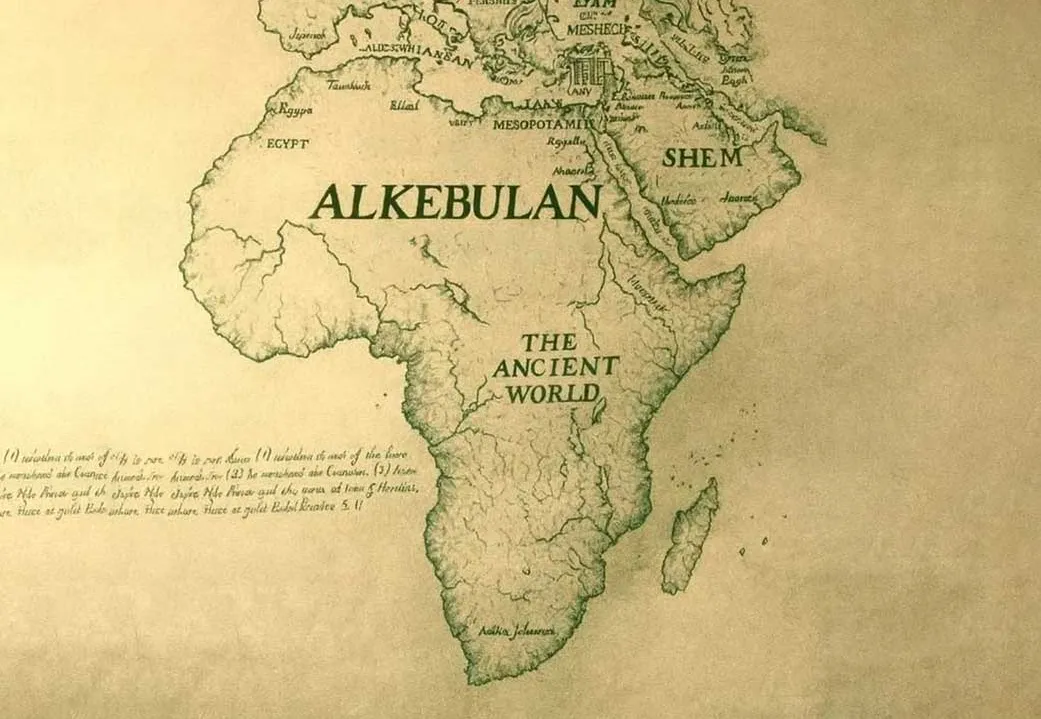
Although it circulates widely on social media, in alternative history blogs and in some cultural discourse linked to Pan-Africanism, the idea that “Alkebulan” was the original name of the African continent is not supported by solid historical evidence. The designation has gained popularity mainly in recent decades, often associated with an effort at identity-based and symbolic reclamation, but it lacks a documentary basis in the known ancient sources.
Over time, it has become increasingly common to find references to the term Alkebulan as Africa’s alleged ancestral name – supposedly predating contact with the Greeks, Romans and other European peoples. The word is often interpreted as meaning “mother of humanity” or “garden of Eden”. Many of its advocates maintain that the name “Africa” was imposed during periods of conquest and colonisation.
According to academic and historical sources gathered by Wikipedia, there is no known record proving the use of “Alkebulan” in Antiquity as an official or widely accepted designation for the African continent. The term is said to have emerged only in the 20th century, within Afrocentrist and Pan-Africanist movements, as part of an effort at cultural affirmation and identity repositioning.
During our research, Wikipedia proved to be the only credible source with structured references, drawing on relevant authors within the Afrocentric movement, such as Molefi Kete Asante, Cheikh Anta Diop, Yosef Ben-Jochannan and John Henrik Clarke. Despite their cultural influence, many of these names are also criticised by mainstream historians, owing to the lack of documentary evidence for some of their claims. One of the best-known criticisms comes from the academic Mary Lefkowitz, who contests several Afrocentric ideas, notably on the identity of Ancient Egypt.
Controversial origins
Some texts wrongly attribute to Cheikh Anta Diop the idea that Alkebulan was the first name of Africa, citing a supposed work entitled Kemetic History of Afrika. However, this work does not appear in the author’s official bibliography, and there is no record that Diop used this designation with that meaning.
The modern origin of the word is often associated with Yosef Ben-Jochannan, whose ideas – although widely circulated in Afrocentric circles – are not considered academic in the traditional sense. On specialist forums such as AskLinguistics, users identified a passage in his book Black Man of the Nile and His Family, in which Ben-Jochannan states that Alkebu-lan was the oldest name for Africa, used by Nubians, Ethiopians, Carthaginians and Mozarabs. However, this statement is not accompanied by historical sources or supporting documentation.
Furthermore, linguistics specialists stress that Alkebulan lacks a solid etymological basis. In Arabic, the prefix “Al-” means “the”, but “kebulan” is not a recognised word either in Arabic or in recorded ancient African languages. Wikipedia reinforces this criticism, noting that there are no ancient documents confirming the use of the word, the term being used mainly in Pan-Africanist discourse and modern identity movements.
Other popular sources
Despite the absence of academic validation, several popular websites continue to propagate the idea that Alkebulan was the continent’s original name. Platforms such as WorldAtlas, Pulse Nigeria and Away to Africa offer definitions such as “motherland”, “garden of Eden” or “mother of humanity”, associating the term with historical peoples such as the Nubians and Ethiopians. These sources, however, present no documentation or archaeological evidence to support these claims.
In the case of the website Away to Africa, for example, the name is attributed to different linguistic interpretations linked to ancient African cultures, including terms such as AfRAka or Afru-ika, supposedly used by the Dogon and other peoples. Once again, however, no concrete proof is offered of their actual or widespread use in Antiquity.
Alkebulan in contemporary culture
Despite the absence of historical evidence, the term Alkebulan has gained significant visibility in contemporary culture, especially in literary works and digital publications of a symbolic, fictional or educational nature. On Amazon, for example, it is possible to find several books with Alkebulan in the title, including:
Alkebulan: Africa Unveiled – The Rich Tapestry of African History and the Impact of Colonization
Alkebulan: Our Africa or Theirs
Alkebulan: Seven Generations
Essien of Alkebulan (a collection of fiction inspired by African myths)
Alkebulan: When Lions Roar
These works, although culturally relevant, are not academic publications and offer no historical evidence of the use of the term in Antiquity. They serve above all as artistic expression, a reflection of African identity and a critique of colonialism, with strong appeal among readers interested in stories of African origin and in the reinterpretation of historical narratives.
It is plausible to imagine that Africa had other names before colonisation; however, without historical records, it is not possible to confirm this hypothesis.
Between cultural myth and historical rigour
Despite the absence of concrete evidence, Alkebulan continues to be used by many as a symbol of African identity, resistance to the colonial legacy and reconnection with deep cultural roots. Its value lies, for these movements, more in symbolism than in historiographical precision.
However, from the standpoint of documented history, there is no verifiable evidence that Africa was known as Alkebulan in Antiquity. The most reliable records – including those analysed in repositories such as Wikipedia and cited in academic forums – do not support this hypothesis. It is plausible to imagine that Africa had other names before colonisation; however, without historical records, it is not possible to confirm this hypothesis.


