
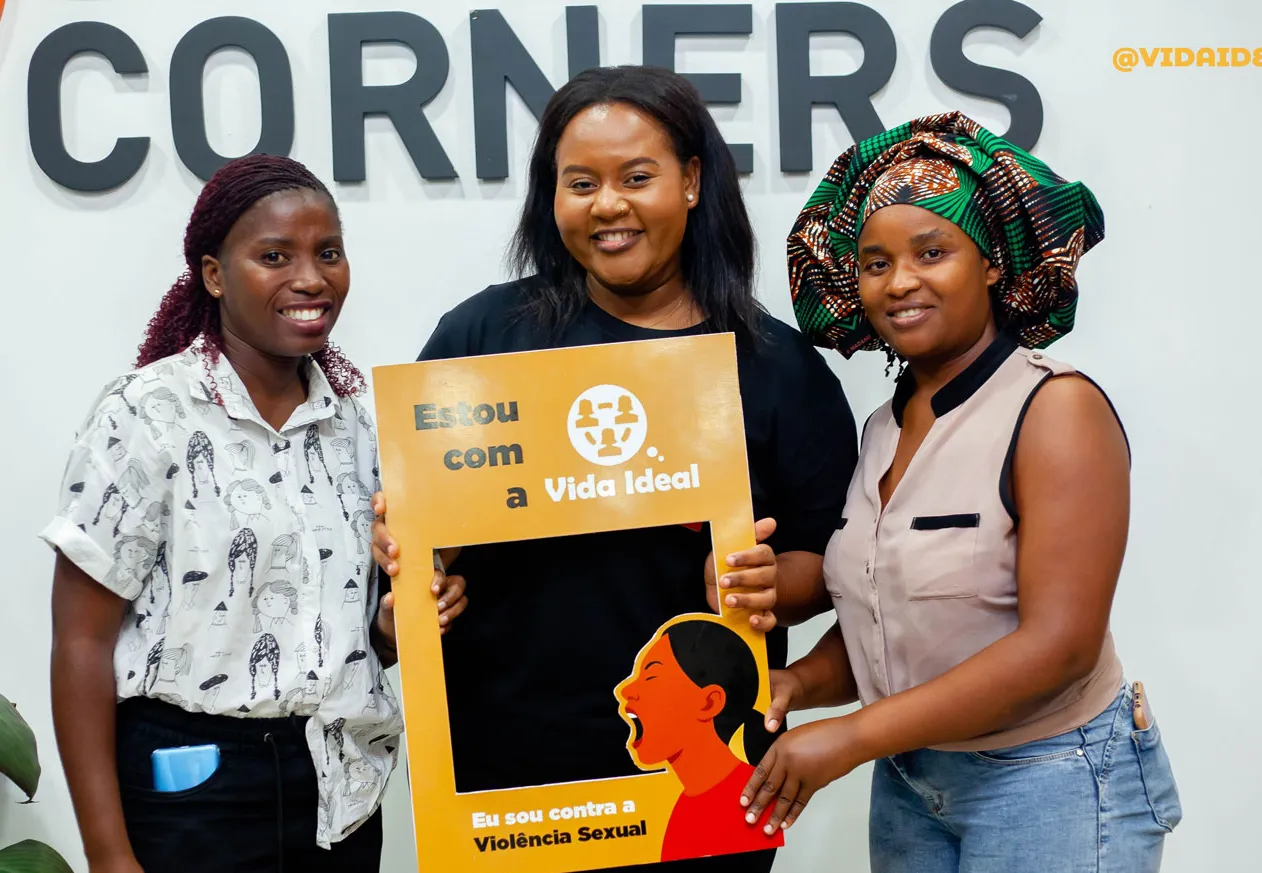
In a country where silence on sensitive subjects still prevails as the rule, and stigma and ignorance still dictate the course of many stories of pain, an initiative is born with a clear and urgent purpose: to educate in order to prevent.
The organisation Vida Ideal has been establishing itself as a firm and empathetic voice in the fight against sexual violence among young people in Mozambique. Through education, awareness-raising and concrete action, the organisation is committed to building communities that are safer, better informed and prepared to protect their children and adolescents.
Educating to protect: Vida Ideal’s mission
Vida Ideal is an organisation committed to promoting healthy environments for the growth of Mozambican youth. Recognising that sexual violence remains a painful and persistent reality in the country, it decided to focus its efforts on prevention — understood not as an isolated act, but as a continuous process of education and dialogue. The mission is clear: to equip young people, parents, educators and community leaders to approach the issue in a safe, clear and empathetic way. In a society where taboo often prevents reporting and support, Vida Ideal offers practical tools to break the cycle of misinformation. Its work extends to public schools, suburban neighbourhoods, youth centres and community forums, bringing with it carefully prepared support materials: manuals for parents, guides for educators, booklets for young people and specific guidance for community leaders. All in accessible, educational and culturally sensitive language.
A workshop that opens doors to dialogue
Recently, the organisation held a workshop entitled “How to Talk to Young People about Sexual Violence”, a notable initiative that brought together young people, educators, activists and community representatives in a space for sharing, active listening and the collective building of solutions. More than a training session, it was a real laboratory of ideas and experiences, where effective strategies for approaching the subject of sexual violence with young people were discussed. Appropriate language, empathetic reception and the role of adults as safe guides were some of the highlights. The experience was deeply enriching and transformative, making clear the need to multiply this type of meeting across the country.
A campaign that is expanding
But Vida Ideal does not stop there. The organisation is driving a national community mobilisation campaign aimed at influencing public policy, strengthening institutional responses and equipping citizens with tools to intervene and support victims. The aim is clear: to transform realities.
Carla Freia, Founder and Executive Director of Vida Ideal, explained that the organisation’s new campaign has as its main objective to promote open, safe and informed conversations about the phenomenon of sexual violence. “We want to create an environment where young people feel comfortable talking, asking questions and learning about what sexual violence is and how they can protect themselves,” she said. The campaign seeks to explain clearly what constitutes this type of violence, how it occurs, what the warning signs are and what routes are available for reporting. “We are working to demystify the subject and break the silence that still surrounds it, especially in communities where fear or shame prevails,” she added. The initiative includes interactive workshops, distribution of educational manuals and specific training, adapted to different audiences, with the mission of equipping adolescents, parents, educators and community leaders with practical tools and accessible language.
On collaboration with the State and other organisations, Carla Freia highlighted the importance of joint, structured action. “No single entity can tackle this problem on its own. Our strength lies in joining forces,” she stressed. Vida Ideal intends to work in coordination with public institutions — schools, health centres, social services and offices supporting children and women — so that the prevention of sexual violence is effectively incorporated into school curricula and child protection policies. “We are also establishing partnerships with civil society networks, human rights defenders and religious institutions, because we believe that change needs to be built from the grassroots, respecting local contexts,” she said. To strengthen this joint action, Vida Ideal undertakes to make available relevant data, specialist training and technical recommendations, thus contributing to more effective and truly humane public policies.
As for expanding the campaign to other provinces, Carla Freia shared her medium-term vision. “We want to reach more than 5,000 young people and adolescents directly, and to impact around 15,000 people indirectly, through our community activities and educational materials,” she explained. One of the main pillars of this expansion is the training of community facilitators: “We plan to train 300 people — including teachers, health technicians, social workers and community leaders — so that they become agents of change in their own localities.” Carla stressed that true impact is measured not only by numbers but by the cultural change the campaign aims to bring about. “Our aim is for sexual violence to stop being normalised and for respect for the body and for human dignity to be the norm, not the exception,” she said with conviction.
Finally, she underlined the essential role of civil society in this process. “Change begins with each one of us. We cannot go on treating this problem as if it were only someone else’s,” she declared. Carla highlighted various forms of active involvement: from promoting spaces for dialogue in neighbourhoods, schools, churches and families, to taking part in workshops, spreading informative content and advocating fairer and more inclusive public policies. “We count on volunteers, donors and institutions that can contribute resources, time and knowledge. Every gesture counts,” she said. And she concluded: “It is not enough to condemn violence — we must act with courage and persistence to prevent it and, one day, to eradicate it completely”.
In a country whose future depends, to a large extent, on protecting its young people, initiatives like those of Vida Ideal are indispensable. To educate is to prevent. To speak is to protect. To act is to transform. And that is precisely what this organisation has been doing — with seriousness, courage and hope.


